Core values

Every data problem
traces back to leadership.

Data is not good or bad on its own. It is a record of the decisions, processes, and standards someone set — or did not.

We have spent nearly thirty years inside SAP data programs, starting with the 1997 Lucent Y2K ECC migration. Here is what we believe, and how we work.

What we've learned

Four positions, earned the expensive way.

It's a leadership problem.

When a program goes sideways, the data usually gets the blame. But the data did not decide to skip the ownership conversation, tolerate the silo, or leave the design call unmade for six weeks. People did. Most leaders are not failing on purpose — they have been handed something they were never equipped to lead.

What it means

That is fixable, but only if someone says it out loud.
Pay now, or pay at go-live.

A bad record costs almost nothing to fix when it is created. It costs roughly ten times more during the project, when it is cleansed under deadline pressure. At cutover it costs ten times more again. After go-live, it can stop a line. We have seen that last one: one missing Production Version, a production line down for three hours, about $70,000 — twenty years ago.

What it means

The cheapest moment to fix a record is the moment it is created.

99% isn't good enough.

Ninety-nine percent of your materials can be right, and the one percent can shut down a plant. We see the same seven patterns in almost every program.

What it means

AI does not fix those seven problems. It multiplies them. And you cannot put an AI agent in timeout.

Engineer out the heroics.

The war room is not dedication. It is evidence of a broken process — sixteen-hour days, missed weekends, the holiday the program quietly took, the one person who cannot take vacation because the data lives in their head. Heroes burn out and leave, and the knowledge walks out the door with them.

What it means

Everyone went home at night. It went so well the team got cut.

Pay now, or pay at go-live

The same record, four prices.

A rule of thumb, not a study — but every program we have seen pays this ladder in one direction only.

  1. 1×
    Now, in ECC

    A rule at creation, an owner, a weekly report

  2. 10×
    During the project

    Bulk cleansing under deadline, consultants by the hour, mock loads rerun

  3. 10× again
    At cutover

    The war room, weekend heroics, freezes that stop the business

  4. 100×
    After go-live

    The line goes down. $70,000 in three hours for one missing Production Version

The cheapest moment to fix a record is the moment it is created. Every week a program runs without governance, it adds new records to the bottom of this ladder.

99% isn't good enough

The same seven patterns, in almost every program.

Five of them have a name and a face. They are in The Data Crime Files, because a problem nobody will name is a problem nobody can fund.

  1. Nobody has defined what good looks like.

    You cannot measure against a standard that was never written down. Most programs discover this at the first mock load, when two people disagree about whether a record passed.

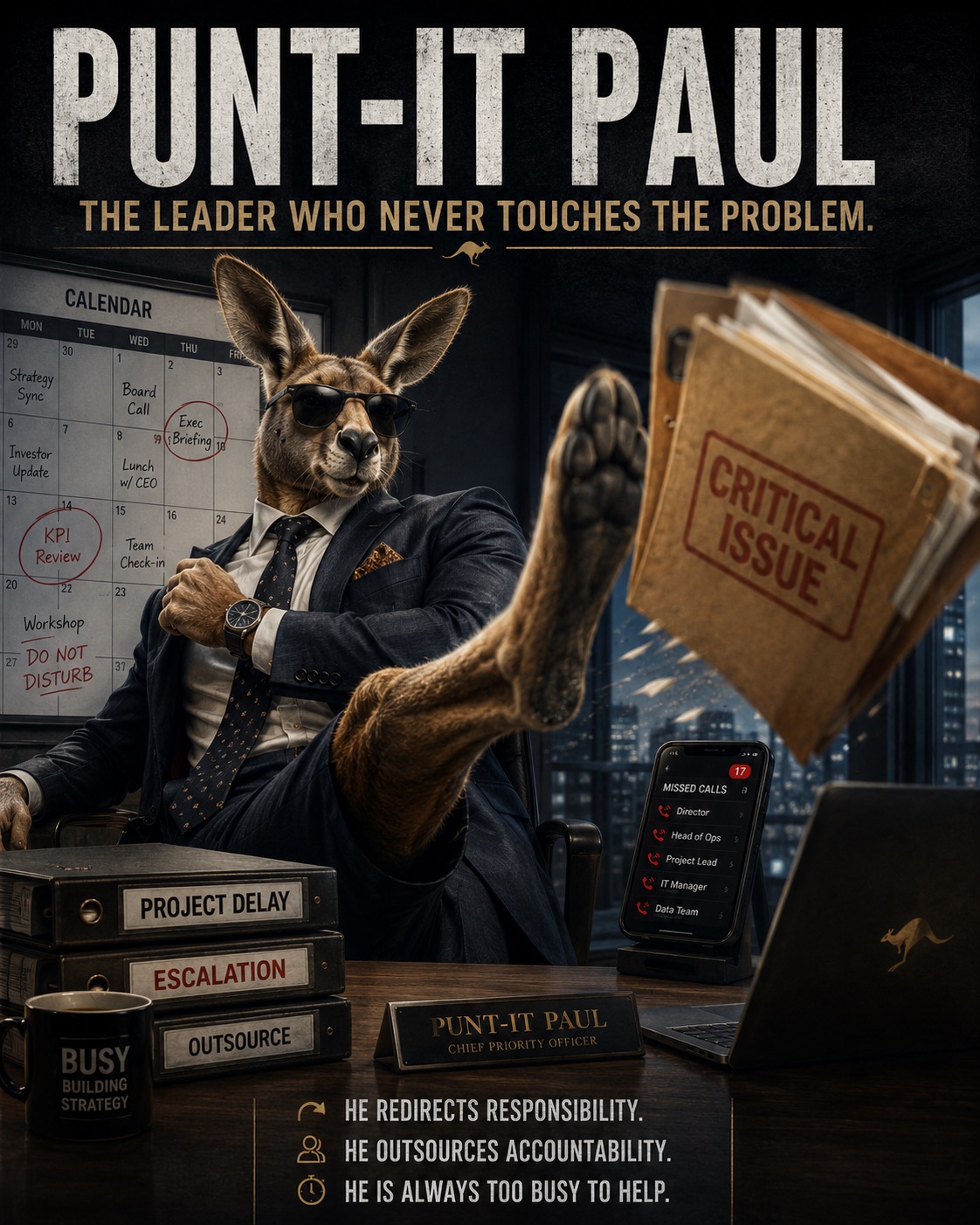
  2. Punt-It Paul — Chief Priority Officer

    Nobody wants to own the data.

    Everyone touches it. Nobody is accountable for it end to end. Ownership gets assigned to a committee, which is another way of saying it was not assigned.

    Punt-It Paul →
  3. The Spreadsheet Smuggler — Partner in Crime

    There is no disciplined process.

    The rules live in one person's head and the real data lives in a spreadsheet beside the system. Both work until the person leaves or the volume doubles.

    The Spreadsheet Smuggler →
  4. "99% is good enough."

    It is, until the one percent is the material that stops the line. A percentage is a comfortable way to describe a number of records nobody has counted.

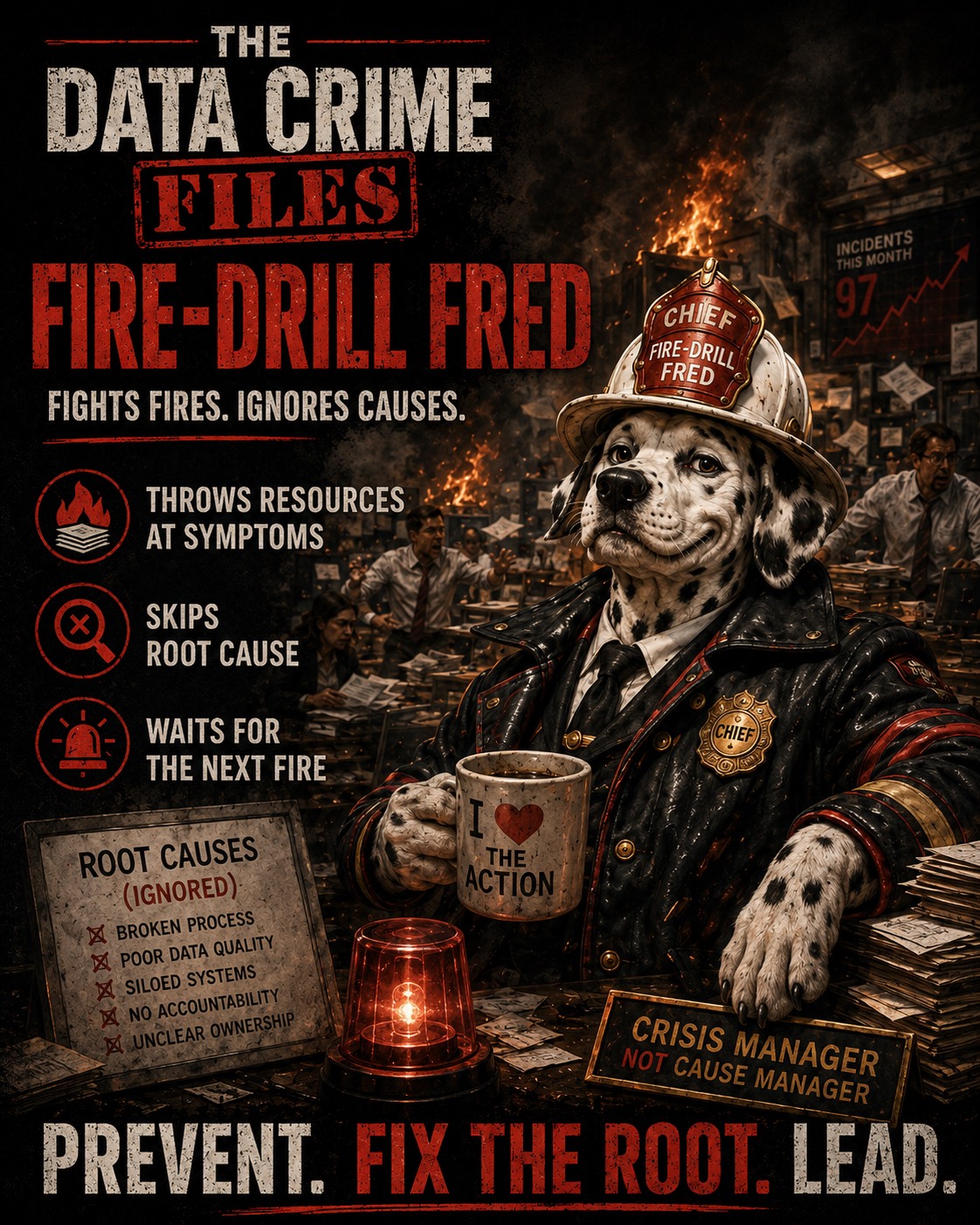
  5. Fire-Drill Fred — Crisis Manager, Not Cause Manager

    Teams admire the problem instead of fixing it.

    The same issue is presented at the same meeting every week, with a slightly newer slide. Reporting on a fire is not the same as putting it out.

    Fire-Drill Fred →
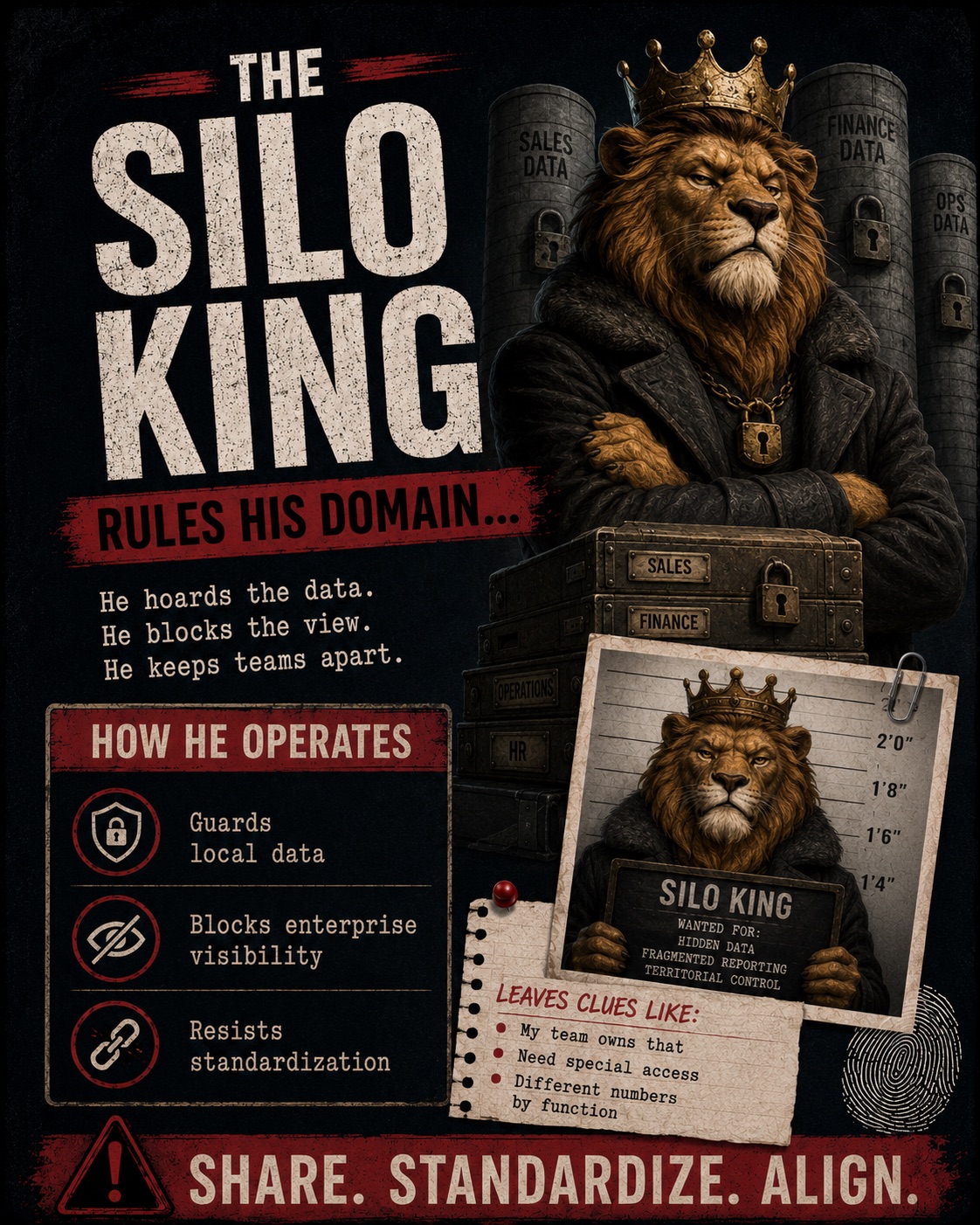
  6. The Silo King — Ruler of the Data Fiefdom

    The people fixing data and the people creating it do not talk.

    One team cleanses what another team keeps producing. Both are working hard. The defect rate does not move.

    The Silo King →
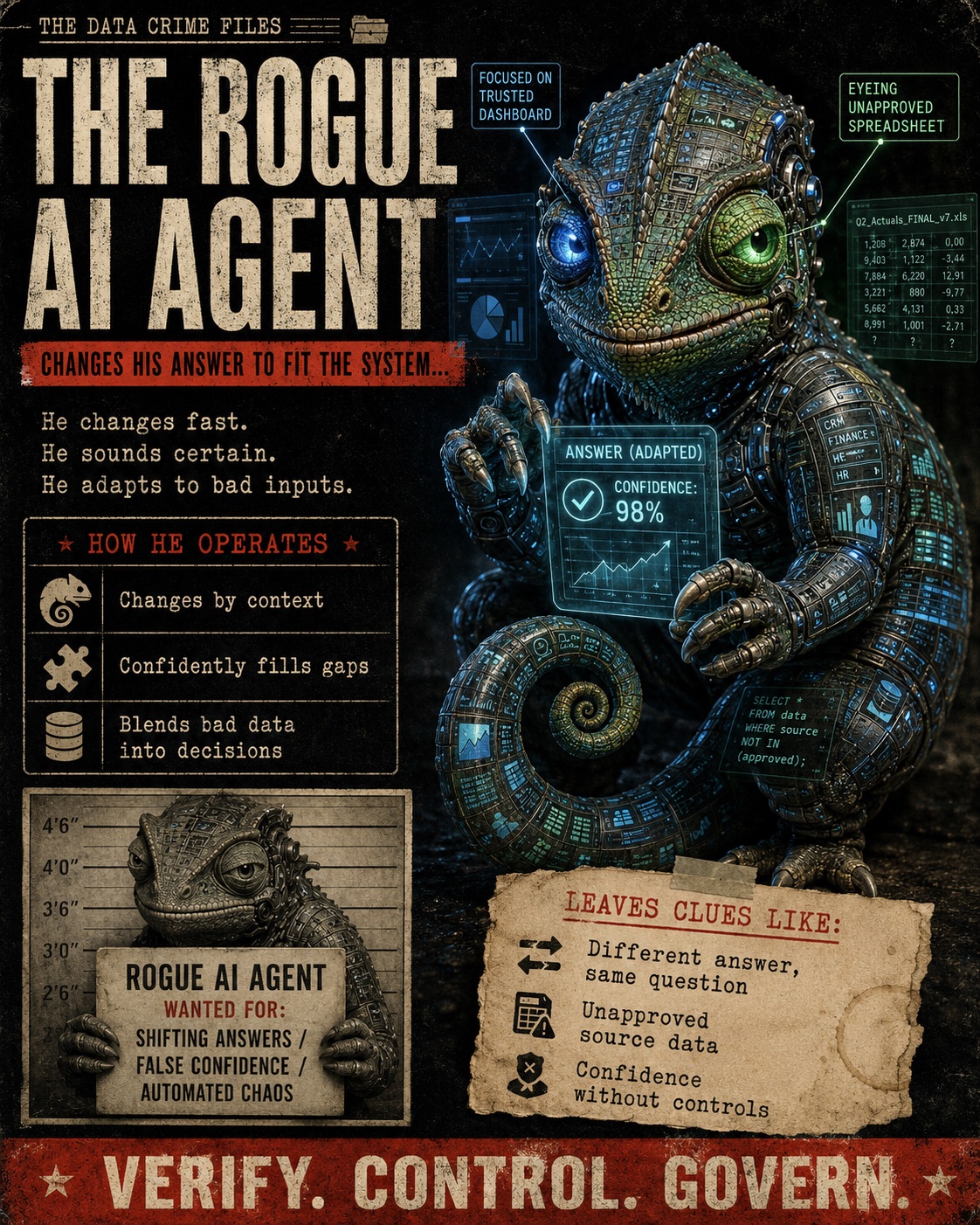
  7. The Rogue AI Agent — Changes His Answer to Fit the System

    Nobody trusts the data.

    So the planning moves to spreadsheets, the reports get checked by hand, and there is no foundation for automation or AI — because automation needs data somebody is willing to stand behind.

    The Rogue AI Agent →

AI does not fix those seven problems. It multiplies them — and you cannot put an AI agent in timeout.

How we work

Nine values. Each one has a behaviour behind it.

These are commitments, not slogans. You can hold us to every one.

  1. We engineer out the heroics.

    Repeatable rules and validation, not one person's spreadsheet and memory.

  2. Business value, not IT work.

    If it does not keep product moving, cash flowing, or risk down, we do not do it.

  3. Clarity over complexity.

    If we cannot explain it to your CFO, we have not finished thinking.

  4. Discipline over done.

    We change the oil instead of replacing the engine.

  5. We reserve the right to get smarter,

    so you never pay the ignorance tax. When the data talks back, we update the spec, change the rule, and make the call — early, while it is cheap.

  6. Your time is the most precious resource.

    No months-long data freezes. Answers in two weeks.

  7. Integrity you can verify.

    We show you the evidence, including the bad news. We never invent a story.

  8. Generosity and service.

    We give away what we know, promote the people we learn from, and leave clients more capable than we found them. We have a moral obligation to lead well.

  9. We guarantee our work.

    No one should pay for incompetence. Every consultant ALLJOY places with you comes with a two-week money-back guarantee: if you are not satisfied after the first two weeks, we do not invoice you for that consultant.

Value five, in practice

We reserve the right to get smarter.

What this protects against

Programs rarely fail because someone made a bad early call. They fail because someone defended a good early call three months past its expiration date — because reversing it would have looked like being wrong.

That is ego wearing the costume of consistency. It is expensive, it is quiet, and by the time it surfaces it has already shaped the build.

We embrace the new information. We do not embrace our ego.

The governing rules

  1. Decisions have expiration dates.

    Every spec, every design choice, every assumption carries the timestamp of what was known when it was made. Revisit them on purpose, not by accident. A decision nobody has re-examined since kickoff is not settled — it is stale.

    Operating rule

    Date the decision. Then check it.

  2. Evidence changes the call. Opinion does not.

    This is not permission to thrash. New test results, new data profiling, new constraints, a genuinely better method — those reopen a decision. A new voice in the room with a preference does not. The change must be named, owned, priced, and documented like any other decision.

    Operating rule

    Bring evidence or bring nothing.

  3. Nobody gets penalized for the decision that was right at the time.

    The person who wrote the spec is not on trial when the spec changes. The moment authorship becomes liability, people stop surfacing what they have learned — and the program starts paying for that silence.

    Operating rule

    Retire the decision. Protect the author.

  4. Say it out loud before you need it.

    “I expect this to change. When it does, bring it to me early.” Leaders who say that in week one get the truth in week twelve. Leaders who don't, get it in UAT.

    Operating rule

    Grant permission to get smarter before the program has to ask for it.

Being right at the time is not the same as being right now. Strong programs know the difference and act on it while it is still cheap.

Getting smarter is not a course correction you have to apologize for. It is the whole reason you looked.

The rule behind the rules

We are for the outcome, not against the incumbent.

We name what we would do rather than what anyone else did. Other firms are not the point. The work is the point.

This is what we believe.
The rest is applying it early.

Thirty minutes. We'll review your program against these four positions and tell you where it stands — and what it takes to change it.